
Benign Prostatic Hyperplasia (BPH) Treatment in Khatib & Yishun
Assessment and Treatment for an Enlarged Prostate
Benign Prostatic Hyperplasia (BPH), commonly known as an enlarged prostate, is one of the most common causes of urinary symptoms in older men.
At GreenLink Medical Clinic in Khatib, we provide assessment and treatment for BPH, including prostate examination, PSA blood testing and medications to improve urinary symptoms for patients from Yishun and across North Singapore.
What is Benign Prostatic Hyperplasia (BPH)?
Benign Prostatic Hyperplasia (BPH) is a non-cancerous enlargement of the prostate gland that commonly occurs as men get older. It is one of the most common causes of urinary symptoms in men over the age of 50.
The prostate is a small gland located just below the bladder. The urethra, the tube that carries urine out of the body, passes through the centre of the prostate.
As the prostate gradually enlarges with age, it can compress the urethra and partially block the flow of urine. This causes symptoms such as a weak urine stream, difficulty starting urination, frequent urination and waking several times during the night to pass urine.
Although BPH is not prostate cancer and does not increase the risk of developing prostate cancer, both conditions can occur in older men. This is why a proper medical assessment is important.
Key Facts About BPH
✔️ Benign means non-cancerous.
✔️ Hyperplasia means an increase in the number of prostate cells, causing the gland to enlarge.
✔️ BPH becomes increasingly common with age.
✔️ The enlarged prostate presses on the urethra, restricting urine flow.
✔️ BPH is not prostate cancer, although both conditions can produce similar urinary symptoms.
✔️ Assessment helps distinguish BPH from other causes of urinary symptoms.
Common Symptoms of BPH
➡️ Frequent urination
➡️ Waking at night to pass urine (nocturia)
➡️ Weak urine stream
➡️ Difficulty starting urination
➡️ Dribbling after urination
➡️ Feeling that the bladder is not completely empty
➡️ Sudden urge to urinate
Understanding How BPH Causes Urinary Symptoms
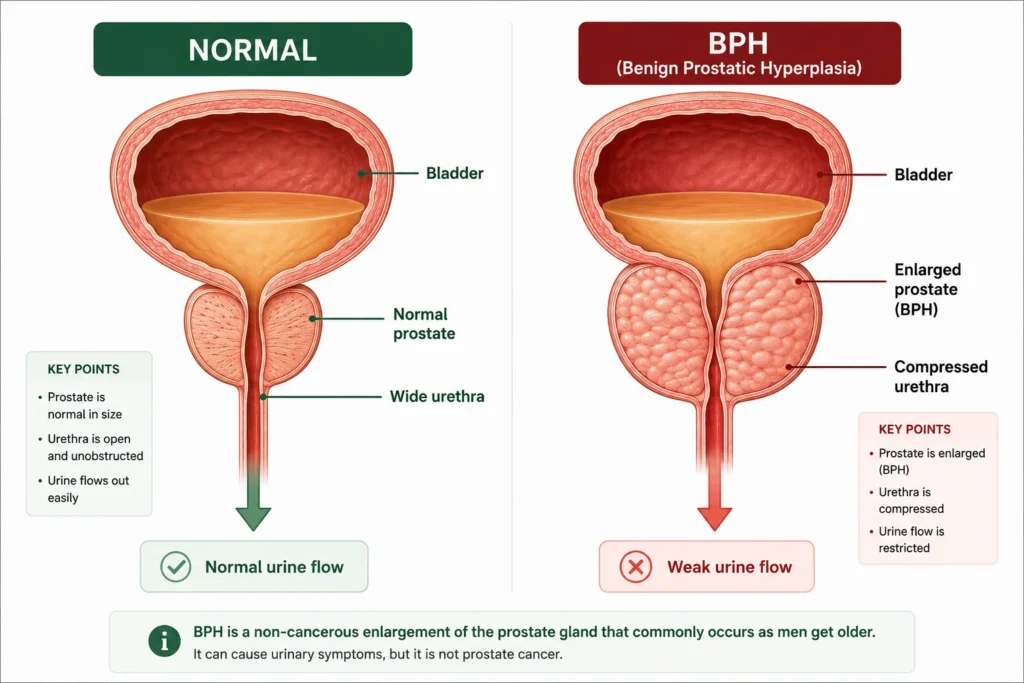
As the prostate enlarges, it compresses the urethra and partially blocks the flow of urine. This can result in a weak urine stream, difficulty starting urination, incomplete bladder emptying and frequent urination.
When Should You See a Doctor?
- Blood in urine
- Pain when passing urine
- Fever with urinary symptoms
- Inability to pass urine (medical emergency)
- Recurrent urinary tract infections
- Worsening urinary symptoms
How is BPH Diagnosed?
Assessment of Benign Prostatic Hyperplasia (BPH)
Many men assume urinary symptoms are simply part of ageing.
However, similar symptoms can also be caused by urinary tract infections, bladder conditions or, less commonly, prostate cancer.
A careful assessment helps identify the underlying cause and guides the most appropriate treatment.
At GreenLink Medical Clinic, your assessment may include:
Medical History
- Urinary symptoms and how long they have been present
- Frequency of daytime and night-time urination
- Difficulty starting urination
- Weak urine stream
- Urgency or leakage
- Current medications Other medical conditions
Physical Examination
A physical examination is an important part of assessing men with suspected BPH.
This usually includes a Digital Rectal Examination (DRE), during which your doctor gently examines the prostate through the rectum.
The examination helps assess:
- The size of the prostate
- Whether the prostate feels enlarged
- Whether there are any abnormal lumps, hard areas or irregularities that may require further investigation
Although some men feel embarrassed about the examination, it is usually quick, well tolerated and provides valuable clinical information.
Prostate-Specific Antigen (PSA) Blood Test
A PSA (Prostate-Specific Antigen) blood test may be recommended as part of the assessment.
PSA is a protein produced by the prostate. While PSA levels may be raised in men with BPH, they can also be elevated due to prostatitis, urinary infections or prostate cancer.
The PSA result is interpreted together with:
- Your age
- Your urinary symptoms
- Findings on the physical examination
- Your overall clinical assessment
An abnormal PSA result does not necessarily mean prostate cancer, but it may require further evaluation.
Additional Tests
Depending on your symptoms, additional investigations such as a urine test or referral for further imaging may sometimes be recommended.
Health Screening
PSA (Prostate-Specific Antigen) blood test is often ordered as part of our Health Screening Packages.
Take a look at our Health Screening Page to find out more.
Treatment for Benign Prostatic Hyperplasia (BPH)
Lifestyle Measures
Many men with mild urinary symptoms benefit from simple lifestyle modifications, including:
- Reducing fluids before bedtime
- Limiting caffeine and alcohol
- Avoiding holding urine for prolonged periods
- Maintaining a healthy weight
- Regular physical activity
Medical Treatment
Many men experience significant improvement with medication.
Treatment is tailored according to your symptoms and overall health.
Alpha Blockers (Tamsulosin)
☑️ Improves urine flow
Low-Dose Daily Tadalafil
☑️ Improves urinary symptoms and may also help erectile dysfunction
5-Alpha Reductase Inhibitors (Finasteride/Dutasteride)
☑️ Gradually shrinks the prostate
Solifenacin (Vesicare®)
☑️ Treats overactive bladder symptoms such as urgency and frequency
Alpha-1 blockers (e.g. Tamsulosin)
Alpha-1 blockers such as Tamsulosin, are one of the most commonly prescribed medications for Benign Prostatic Hyperplasia (BPH).
They work by relaxing the muscles around the prostate and bladder neck, allowing urine to flow more easily.
✔️ Relaxes the muscles around the prostate and bladder neck
✔️ Improves urine flow
✔️ Reduces difficulty passing urine
✔️ Usually starts working within days to weeks
5-Alpha Reductase Inhibitors (Finasteride & Dutasteride)
Medications such as Finasteride and Dutasteride work differently from Tamsulosin.
Rather than relaxing the muscles around the prostate, they gradually reduce the size of the prostate by blocking the conversion of testosterone to dihydrotestosterone (DHT), a hormone that contributes to prostate enlargement.
These medications are generally considered in men with significantly enlarged prostates and usually take 3 to 6 months before noticeable improvement occurs.
Potential side effects may include:
• Reduced libido
• Erectile dysfunction
• Reduced ejaculate volume
Daily Low-Dose Tadalafil
Tadalafil is a medication that can improve urinary symptoms caused by Benign Prostatic Hyperplasia (BPH) by relaxing the muscles in the prostate, bladder and surrounding tissues.
It may be particularly beneficial for men who also have erectile dysfunction, allowing both conditions to be treated with a single daily medication.
Solifenacin (Vesicare®)
Vesicare® (solifenacin) may be prescribed for men with BPH who also experience overactive bladder symptoms, such as urinary urgency, frequent urination or urge incontinence.
It works by relaxing the bladder muscle, helping to reduce the sudden urge to urinate and improve bladder control.
Your doctor will determine whether Vesicare® is appropriate based on your urinary symptoms and bladder function.
Possible Complications of Untreated BPH
- Acute urinary retention
- Bladder stones
- Recurrent urinary tract infections
- Bladder damage
- Kidney problems
When is Surgery Recommended?
Most men with BPH can be managed successfully with medication.
However, referral to a urologist may be recommended if:
- Medication does not adequately control symptoms
- Recurrent urinary retention
- Recurrent urinary tract infections
- Bladder stones
- Kidney complications
- Suspicion of prostate cancer
Frequently Asked Questions
Is BPH the same as prostate cancer?
No. BPH is a benign (non-cancerous) enlargement of the prostate and does not mean you have prostate cancer. However, similar urinary symptoms can occur in both conditions, which is why assessment is important.
Will I need surgery?
Most men improve with medication and lifestyle measures. Surgery is usually considered only if symptoms remain severe or complications develop.
Can I stop my medication once I feel better?
Medication should only be stopped after discussing it with your doctor. Some symptoms may return if treatment is discontinued.
Can BPH cause erectile dysfunction?
BPH itself does not directly cause erectile dysfunction, but the two conditions commonly occur together as men get older. In some men, daily tadalafil may help improve both urinary symptoms and erectile function.
Experiencing Urinary Symptoms?
If you are experiencing frequent urination, waking at night to pass urine, a weak urine stream or difficulty emptying your bladder, early assessment can help determine whether BPH or another condition is the cause.
GreenLink Medical Clinic provides assessment and treatment for Benign Prostatic Hyperplasia (BPH) in Khatib, conveniently serving patients from Yishun and the surrounding North Singapore neighbourhoods. Walk-in consultations are welcome during our clinic opening hours.
👉 Visit us today for assessment and treatment.